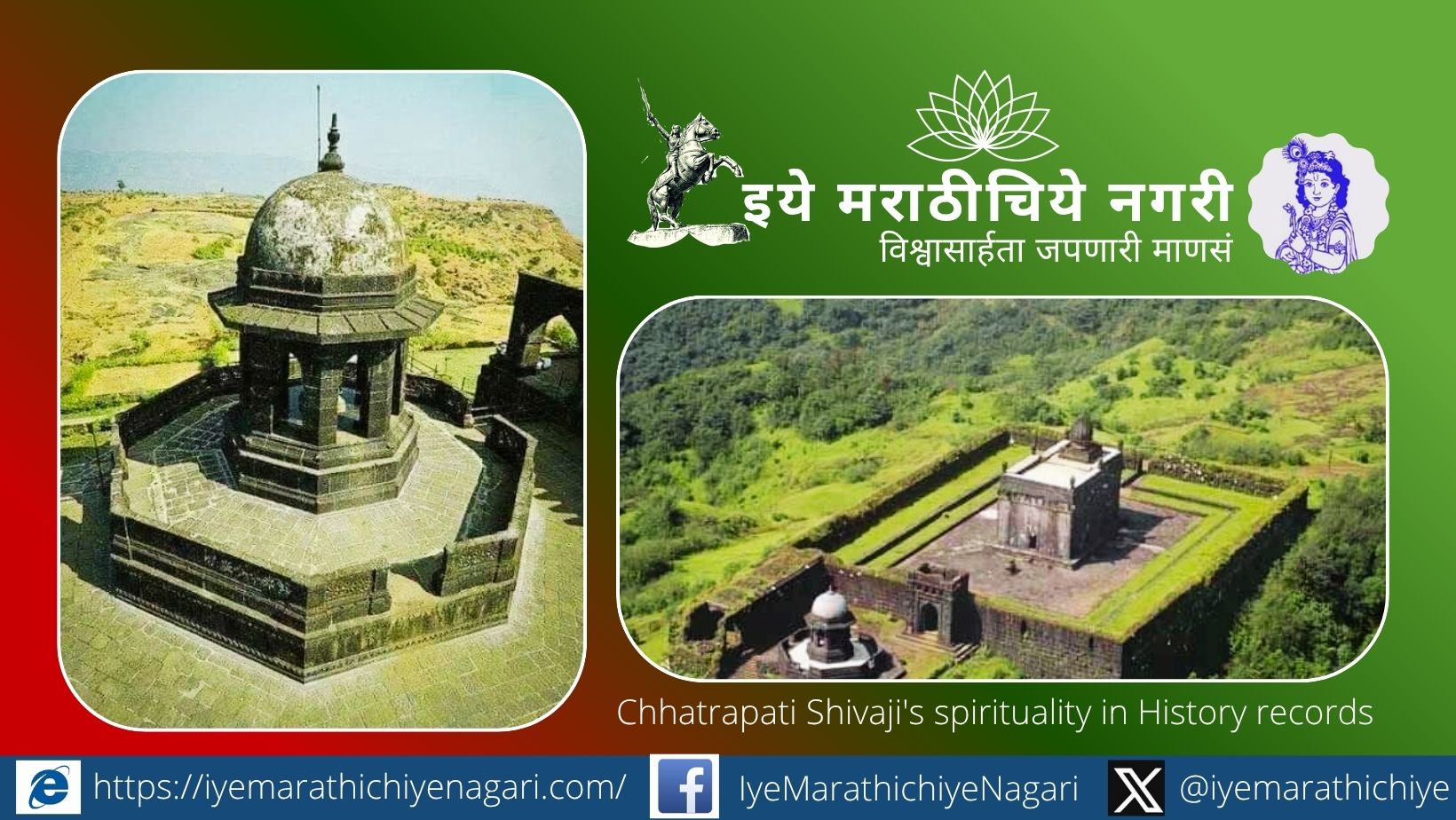
Chhatrapati Shivaji Maharaj had met several saints. Some of these saints had appreciated and praised his work and mission. Although direct evidence of personal meetings with certain saints is not available, it is important to mention their names in recognition of their contribution to the Swarajya established by Chhatrapati Shivaji Maharaj. The following is a list of such saints from the era of Shivaji Maharaj.
- Chintamani Maharaj( Chinchawad,Pune)
- Narayan Maharaj( Chinchawad,Pune)
- Shidheshwar Bhat Bramhe ( Chakan )
- Gopal Bhat ( Mahabaleshwar )
- Mahant Kevalbharati ( Kenjal,Wai )
- Dev Bharati ( Mudalgaon paaodha)
- Mouni Buva ( Patgaon )
- Yakut Baba ( Kelshi Ratnagiri)
- Shitaram Vajpaey ( Karnataka )
- Purshotam Bhat Dharamadhikari ( Kumbh Konam )
- Ratnagiri Gosavi
- Tan Pathak ( Nagthane )
- Shridhar Bhat Bapat ( Ganapati Pule )
- Keshav Bhat Pandit ( Danadhasha )
- Paramanand Gosavi ( Poladpur )
- Narayan aashram ( Trebakeshwar )
- Shitalpuri or Achalpuri ( Banaras )
- Gaga Bhat ( Banaras )
- Sant Tukaram ( Dehu)
- Samartha Ramdas Swami.
Chinchawadkar Deo ( Pune )
Shahaji Raje donate a land to Chintamani Maharaj (1481-1625). Saint Tukaram give name ‘Deo’ to ancestor’s of Chintamani Maharaj. Chhatrapati Shivaji take anugraha from Chinchwadkar Moraya Gosavi Narayan Maharaj. This record is seen in Rajyavewaharkosha by Raghunath Pandit. Narayan Maharaj period was 1601-1719. In this period Shivaji,Sambhaji, Rajaram, Shahu visited to Narayan Maharaj. Shivaji donate a land and finance Chinchwadkar Deo temple to develop the spiritual concept in their state. By the help of Narayan Maharaj Shahu become a Chhatrapati. Chhatrapati Rajaram Maharaj donate a land near Ravet Tal Haveli Dist. Pune in happiness of birth of a child to him. Main concept of Raje to donation of land and finance was to develop the Vedic and spiritual concept in their state.
Shidheshwar Bhat Bramhe
Shidheshwar Bhat Bramhe was Vedshatra Pandit in Chakan Paragana. In1653 the letter written by Chhatrapati Shivaji to Bramhe is in history records. In this he write that because of your bless he become a authorized person in state and get satisfaction. This state is of Swami’s gift of bless.
Gopal Bhat
Gopal Bhat was Vedshatra Pandit in Mahabaleshwar. Chhatrapati Shivaji and Rajmata Jijau take mantra of meditation from him in year 1653.
Keval Bharati
Keval Bharati was from Kenjal in Wai paragana. After the Javali’s victory Shivaji wins the Wai paragana. For this victory he took a bless from him.
Deo Bharati
In year 1670 Chhatrapati Shivaji wins the fort of Swalher at that time he took a anugraha from Deo Bharati are the records in Bakhari. Deo Bharati was from Mudalgao. He was staying in Mahadev temple. From the bless of Deo Bharati he wins the Swalher and Moleher fort in nine days.
Yakut Baba
Kelashi’s Yakut Baba was Muslim saint. But the records of Yakut Baba was very interesting. Shivaji raje gets bless from him.
Sant Tukaram
The above records are from Tukaram Gatha internet copy www.tukaram.com
When Chhatrapati Shivaji call Saint Tukaram to meet him. Saint Tukaram sent above mentioned Abhang’s. In this he wants to tell that there is Pandurang’s ruling government because he is free from death. He is always alive. So every one should have to become such a aatamadyne person. Tukaram Maharaj wants to teach spirituality to him. So he discards his material gifts. Because saints wants only faith in Guru. Many of spirituality loving persons says that Tukaram Gatha is the main origin of Swaraj rules. From this Shivaji knows the characters of real Guru or saint. How they are ? How their work is ? what they want to do ? what they want to develop in our state ? The Mavala’s work on Tukaram Gatha’s concepts. Courage to fight against the enemies and to develop the real spiritual culture in their state that called the Ram Rajya. The Abhanga’s above mention show the real characters of Sadguru. How they love or worship to God Panduranga. Their whole work is for Sadguru only. The real Guru’s far away from money. They do not want material thing like Gold, silver. The Ant and Elephant are the same in Sadguru’s sight i.e. all the higher caste and lower caste are the same in their sight. A common man and a King are also same in their sight. Because both are persons or human only. They have same soul. Here we wants to mention that Tukaram Gatha is a building element in Shivaji’s character . Think other women as a own mother. This character is seen in Shivaji’s laws.
Parmanand Gosavi Nevaskar
He was famous sanskrut Pandit and also Sanskrut poet .His samadhi is at Poladpur in Raigad district. He wrote Anupuran or Shivbharat.The exact period of Shivbharat was unknown.But the period was near 1661.Because Shivabhart records upto appoinment of Trabhak Bhaskar as a main officer at Shrungarpur. He mention that Shivaji’s birth on earth to develop religion and spiritual concepts of happiness,to kill the enemies,protect the holy saints,cow i.e.wild life and holy Bramians. He also says that Shivaji is a Lord Vishnu’s new birth on the earth.
“Pranipatya pravakshami maharajashya dhimataa charit shivarajyashya bharatshetyv bharatam”
Samarth Ramdas Swami
Samarth Ramdas swami says about Chhatrapati Shivaji that he is a only one person in world who can protect the religion.
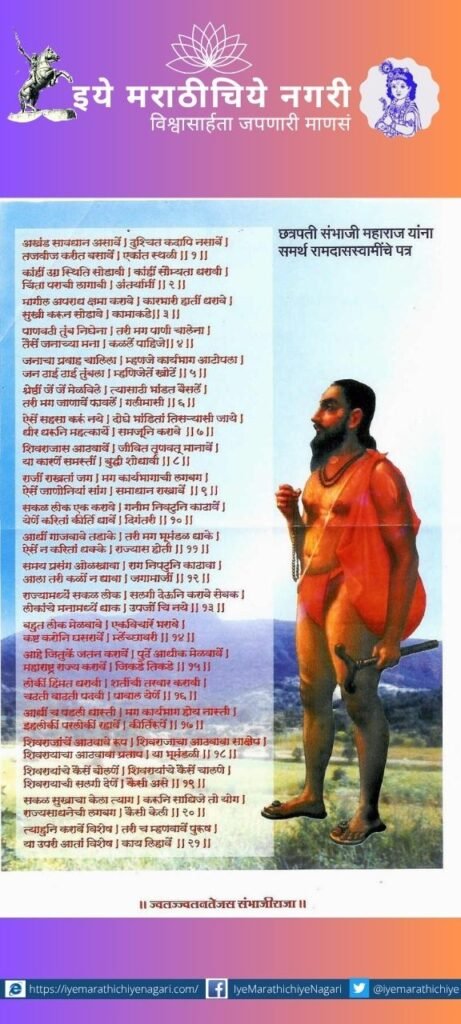
In the letter attributed to Samarth Ramdas addressed to Chhatrapati Sambhaji Maharaj, the saint praises the achievements and character of Chhatrapati Shivaji Maharaj and presents him as an ideal ruler whose legacy Sambhaji should follow. The praise of Shivaji Maharaj in the letter can be understood through several themes:

1. Ideal Protector of Dharma

Ramdas Swami glorifies Shivaji Maharaj as a king who protected dharma (righteousness and religion). He emphasizes that Shivaji established a state where religion, social order, and moral values were safeguarded. This portrayal presents Shivaji as a defender of sacred traditions and ethical governance.

2. Founder of Swarajya

The letter highlights Shivaji Maharaj as the creator of Swarajya (self-rule). Ramdas Swami acknowledges that Shivaji built an independent and just kingdom through courage, determination, and divine inspiration. This achievement is presented as a historic and sacred mission.

3. Model of Courage and Leadership

Ramdas Swami praises Shivaji Maharaj for his bravery, strategic intelligence, and ability to defeat powerful enemies. His leadership is described as disciplined and purposeful, showing how a righteous king should combine strength with wisdom.

4. Righteous and Just Administration

The saint appreciates Shivaji Maharaj’s rule as one based on justice, good governance, and care for the people. He suggests that Shivaji ruled with fairness and responsibility, protecting both society and the state.

5. Spiritual and Moral Character

Ramdas Swami also emphasizes Shivaji’s moral discipline, humility, and devotion to God. By highlighting these qualities, he presents Shivaji as a king whose political success was supported by spiritual strength.

6. An Example for Sambhaji Maharaj

The purpose of praising Shivaji Maharaj in the letter is also instructive. Ramdas Swami advises Sambhaji Maharaj to follow the same ideals—courage, discipline, justice, and devotion—so that the Maratha state may continue to flourish.

Through this letter, Samarth Ramdas Swami glorifies Shivaji Maharaj as a righteous king, a defender of dharma, the founder of Swarajya, and a spiritually guided leader. The praise serves both as recognition of Shivaji’s historic achievements and as moral guidance for Sambhaji Maharaj to preserve and strengthen the Maratha kingdom.
Mouni Maharaj
Mouni Maharaj math in Patgaon have following sanadas. Chhatrapati Shivaji gives sanad on 3rd June 1678 and second sanad on 26th March 1679. Chhatrapati Sambhaji Raje gives sanad on 13th september 1680 and 1686. Deshadhikari Kudal prant give sanad on 1679. Maharani Tarabai gives sanad on 25th July 1701.Chhatrapati Lokraja Shahu give sanad on 12th Octomber 1920.
Keshav Bhat Pandit
Keshav Bhat Pandit was working under Rajaram Maharaj.In 1690 he wrote RajaramCharitram. This book was found in library of Saraswati Mahal in Tanjavar.Shri V.C.Bendre found this book and publish in 1931. In this book Keshav Pandit write about the situation of state after the death of Sambhaji Raje.
Gaga Bhatt
Gaga Bhat was Maharashtrian Pandit in Varanashi. In 1663-64 he came to visit Maharashtra. He wrote on religion and social problems and make good decision on religion. His books are Rajyabhsekha prayog, Shivakondey, Samayanay. His main Goddess temples are Shri kashi Vishwanath and Shri Bindu Madhav.
Sant Dnyneshwar mention the characteristics of King in his holy book Dnyneshwari as self originity character ( Swayambhu ) ,courage,brave,brightness,daring,alerness,fighter,donor,worshipper etc. All these characters seen in king Shivaji’s victorious work so Gaga Bhatt vedically declared Shivaji as a King i.e.Rajyabhishek.
Gaga Bhatt was Purohit in Banaras. His ancestors from Paithan,Maharashtra.He born in Banaras.His father Dinkar(Divakar)Bhatt was an analyst.Gaga Bhatt also known as Vishweshwar Bhatt. He was famous as an analyst.In1673,Chhatrapati Shivaji’s secretary Balagi Awagi sent Pandit Bhalchandra Purohit and Pandit Somanath Bhatt Katre to meet Gaga Bhatt at Banaras. Gaga Bhatt come to Raigad to declear Shivaji as a king and made ceremony of Rajayabhishekha of Raje Shivaji .After that he stayed on Raigad for one year and then went to Banaras with Purohit and Katre.Gaga Bhatt’s great grandfather Narayan Bhatt (birth year 1513) was a famous analyst.He wrote so many books on Philosophy.Akabar’s Chief Raja Toradmal was impressed on Philosophy of Narayan Bhatt.Narayan Bhatt reconstructed the Shri Visheweshwar Temple of Banaras. In memory of this work Bhatt dynasty have honour of first adore in Vishweshwar temple today also.